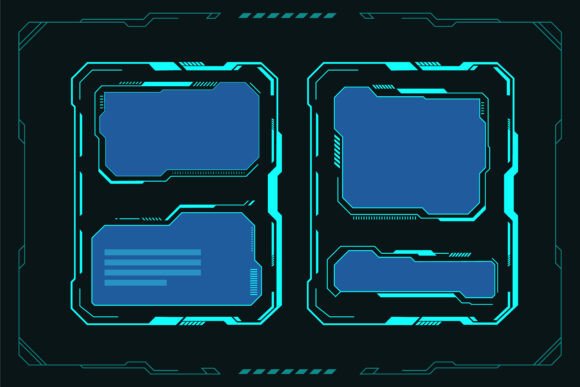
The Evolution of Sci-Fi HUD Interface Design in Modern Digital Ecosystems
In an era where digital experiences increasingly mediate our interaction with reality, the visual language of science fiction has moved from cinematic novelty to functional necessity. Sci-Fi HUD interface design — once confined to the heads-up displays of futuristic spacecraft in films — now powers dashboards, gaming overlays, virtual reality environments, and control panels across industries. This design discipline blends retro-futuristic aesthetics with contemporary usability principles, creating interfaces that feel both advanced and intuitive. For professionals, creators, and entrepreneurs, understanding this trend is not merely about aesthetics; it is about harnessing a visual vocabulary that signals innovation, efficiency, and immersive engagement.
Today's audiences have been conditioned by decades of science fiction to associate transparent data overlays, angular framing, and dynamic telemetry with high functionality. When a user encounters a Sci-Fi HUD interface design in a gaming environment or a VR training simulation, they instinctively interpret it as precise, data-rich, and futuristic. This psychological shorthand is invaluable for product designers, marketers, and developers who seek to communicate sophistication without lengthy explanations. The design language works because it borrows from a shared cultural lexicon of what "advanced technology" looks like.
The Broader Industry Shift Toward Immersive Visual Languages
The rise of virtual reality, augmented reality, and mixed reality applications has accelerated demand for interfaces that can exist within three-dimensional spaces. Traditional flat UI elements often feel out of place in immersive environments, whereas a well-crafted Sci-Fi HUD interface design integrates seamlessly, appearing as a natural extension of the virtual world. Gaming studios, simulation developers, and enterprise VR platforms are leading this adoption, but the influence extends into automotive dashboard design, medical monitoring systems, and even financial data visualization tools.
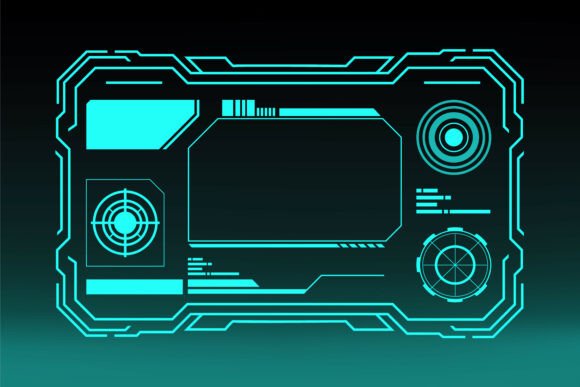
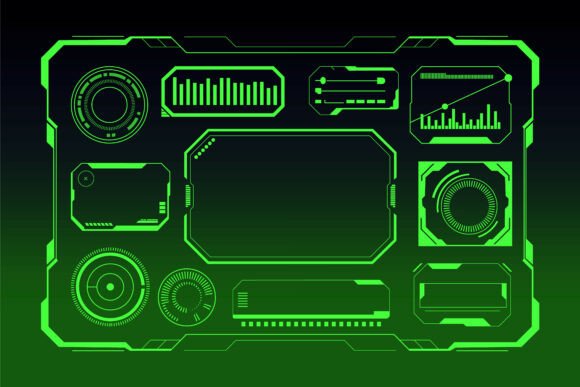
What makes this design approach particularly relevant today is its adaptability. The fully editable vector nature of modern Sci-Fi HUD interface design assets allows teams to customize every element without starting from scratch. Designers can adjust line weights, alter glow effects, or reposition data modules to fit specific screen ratios or interaction models. This flexibility is critical in an environment where iteration speed often determines competitive advantage. When source files are provided in formats such as EPS, teams can scale components from smartwatch displays to wall-sized control room panels without losing fidelity.
Entrepreneurs and freelancers who offer design services have found that incorporating Sci-Fi HUD interface design elements into their portfolios attracts clients in high-tech sectors. A startup building a drone control app, for example, may not need literal sci-fi styling, but the visual cues of a HUD — target reticles, gradient progress bars, and angular data readouts — convey precision and real-time responsiveness. This is not about mimicking fiction; it is about leveraging proven visual patterns that audiences already associate with high performance.
Why the Market Is Paying Close Attention
Several converging trends explain the growing attention on Sci-Fi HUD interface design. First, the democratization of game development through engines like Unity and Unreal has lowered the barrier to entry, but it has also intensified competition for user attention. A distinctive interface can differentiate a title in a crowded marketplace. Second, enterprise clients in manufacturing, logistics, and defense are adopting VR and AR for training and remote collaboration, requiring interfaces that reduce cognitive load while conveying complex data streams. Third, consumer expectations have evolved through exposure to blockbuster games and films; users now expect dashboards and apps to look dynamic, responsive, and visually engaging.
People are paying attention because Sci-Fi HUD interface design directly addresses a fundamental user need: making dense information digestible at a glance. In a control room scenario, an operator monitoring multiple system parameters benefits from a visual hierarchy that prioritizes critical alerts through color, motion, and placement. The design's characteristic use of translucent panels, neon accents, and layered depth helps separate foreground data from background context, reducing visual clutter. This is not decoration; it is usability engineering rooted in spatial cognition research.
For freelancers and design agencies, offering Sci-Fi HUD interface design as a specialty opens doors to clients developing next-generation products. A VR fitness application, a telemedicine platform, or a smart home control system can all benefit from interface elements that communicate speed, connectivity, and intelligence. The ability to customize colors extensively — up to 100 variations in well-constructed design systems — means that the same base layout can be adapted to different brand identities without losing its core visual impact. This scalability is a practical advantage for agencies managing multiple client projects.
Changing Workflows and Expectations in Design Practice
The traditional design workflow for creating a custom HUD interface involved hours of manual vector work, careful gradient placement, and trial-and-error testing across screen sizes. Today, the availability of modular Sci-Fi HUD interface design kits has transformed this process. Designers can now start from a set of professionally crafted components, then modify shapes, adjust color palettes, and reconfigure layouts to match project requirements. The expectation of "easy to resize and modify" is not a luxury; it is a baseline requirement in fast-paced production environments where asset reuse is critical to meeting deadlines.
Teams working on gaming projects, for instance, often need to produce multiple HUD variants for different character classes, game modes, or difficulty levels. A fully editable vector design allows them to generate these variations systematically. Similarly, in VR development, where UI elements must maintain legibility across varying distances and angles, the ability to tweak individual components without rebuilding the entire interface saves significant development time. The inclusion of source files in EPS format further ensures that assets remain editable across different vector software, from Adobe Illustrator to free alternatives like Inkscape.
Another shifting expectation is the demand for accessibility within futuristic aesthetics. Historically, sci-fi interfaces in media prioritized style over legibility, with tiny text and low contrast. Modern Sci-Fi HUD interface design balances the aesthetic with readability, employing high-contrast color palettes, clear typography hierarchies, and motion that guides attention rather than distracting. This evolution reflects a broader industry movement toward inclusive design, where visual flair does not compromise usability. Designers who can deliver interfaces that look futuristic yet remain accessible to users with visual impairments or color blindness are increasingly valued.
Practical Examples Across Use Cases
Consider a virtual reality training platform for industrial equipment operators. The interface must display machine status, safety alerts, and procedural steps without obstructing the user's view of the physical environment. A Sci-Fi HUD interface design approach works well here: critical safety warnings appear in the peripheral vision with animated glow effects, operational data floats in semi-transparent panels that follow the user's gaze, and progress indicators use sweeping radial fills that are intuitive even for first-time users. Because the design is vector-based, the development team can easily adjust the HUD for different headset resolutions or field-of-view requirements.
In mobile gaming, a real-time strategy title uses Sci-Fi HUD interface design for its resource management dashboard. The interface employs hexagonal data nodes, energy-bar animations, and a dark glass aesthetic that fits the game's futuristic theme. The 100 color customizable feature allows players to choose HUD tints that match their personal preference or improve visibility in different lighting conditions. The result is a player experience that feels personalized without requiring additional development work from the studio.
For a startup building an IoT monitoring dashboard, the interface borrows elements from Sci-Fi HUD interface design to present sensor data in a visually engaging way. Device status is represented by glowing ring gauges, network traffic flows appear as animated particle streams, and alerts use angular badge designs that immediately signal urgency. The fully editable vector source files enable the startup to iterate rapidly as they add new device types or change data visualization approaches based on user feedback. This agility is particularly valuable for early-stage companies that need to pivot quickly.
Connecting to Larger Technological and Business Developments
The growing relevance of Sci-Fi HUD interface design mirrors larger shifts toward real-time data consumption and ambient computing. As more devices enter the Internet of Things ecosystem, users require interfaces that can summarize complex system states without overwhelming them. The visual language of HUDs — with its emphasis on glanceable data, predictive indicators, and spatial organization — offers a template for how future dashboards might function. Automotive heads-up displays, smart glasses interfaces, and even smartwatch faces are already adopting these conventions.
From a business perspective, investing in this design style can be a differentiator in markets where product parity is high. A financial analytics platform that adopts Sci-Fi HUD interface design elements may be perceived as more technologically advanced than competitors using standard chart libraries. While the underlying data and algorithms may be similar, the user experience creates a perceptual advantage. Marketers can leverage this visual identity in promotional materials, reinforcing a brand's position at the cutting edge of innovation.
For freelancers and creators, the availability of well-structured design assets reduces the gap between concept and execution. Instead of spending days constructing individual HUD elements, they can focus on composition, interaction design, and storytelling. This efficiency matters in a gig economy where turnaround time directly impacts income. The combination of fully editable vectors, broad color customization, and included source files means that even solo practitioners can deliver production-ready work that meets professional standards.
Practical Considerations for Adopting Sci-Fi HUD Design Assets
When incorporating Sci-Fi HUD interface design into a project, several practical factors ensure success. First, verify that the design system uses consistent stroke weights, corner radii, and grid spacing — this makes it easier to combine elements from different parts of the asset library. Second, test color combinations across the full customization range early in the process, as some neon hues that look striking on screen may not translate well to printed materials or low-contrast display settings. Third, plan for motion. HUD designs often include animated elements like scanning lines or rotating rings; static vector files can be exported to animation tools, but it helps to have a clear vision for what moves and why.
Another important factor is context. A Sci-Fi HUD interface design that works beautifully in a dark sci-fi game may feel out of place in a medical monitoring app, even if the underlying data display is identical. Designers should evaluate the tone of the overall product and adjust the design accordingly. The 100 color customizable option is particularly useful here, allowing a shift from aggressive red-and-orange gaming palettes to calm blue-and-white medical interfaces while retaining the HUD structural logic. This adaptability broadens the market for such assets beyond entertainment into practical professional tools.
Lastly, consider the end user's environment. In a brightly lit factory floor, a HUD with low opacity and thin glow effects may be hard to read. In a dimly lit VR headset, overly bright elements can cause eye strain. The best Sci-Fi HUD interface design systems include multiple variants or provide guidelines for adjusting opacity, glow intensity, and background contrast. When source files are available in editable formats, these adjustments become straightforward, allowing teams to optimize the interface for specific lighting conditions without compromising the overall aesthetic.
The trajectory of interface design is clearly moving toward more immersive, data-rich, and visually engaging experiences. Sci-Fi HUD interface design occupies a central place in this evolution, offering a proven visual language that resonates with modern users across gaming, VR, enterprise, and consumer applications. For professionals and creators looking to stay relevant, developing a working understanding of this design approach — and having access to flexible, editable assets — is becoming less of an option and more of a strategic necessity. The interfaces of the future will look less like flat rectangles and more like living dashboards, and those who adopt this language today will be best positioned to lead tomorrow.