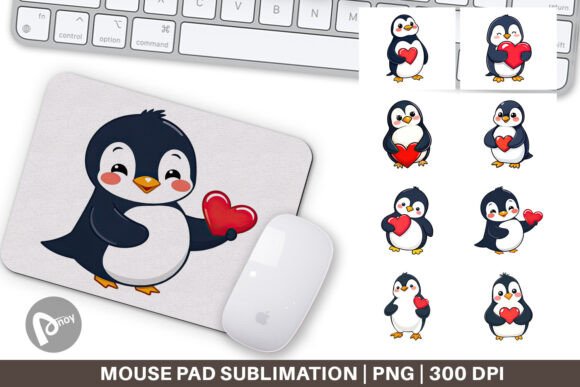
Mouse Pad Penguin Holding a Heart: Why This Design Deserves a Spot on Your Desk
Imagine a small penguin, clutching a rosy red heart, staring up at you from the corner of your desk. It’s a subtle reminder to keep things warm even during a hectic workday. The Mouse Pad Penguin Holding a Heart isn’t just a pretty surface for your cursor—it’s a sublimation-printed accessory that blends personality with practicality. But many people jump at this kind of design without thinking about what makes a mouse pad truly functional. They grab the first cute image they see, only to end up with a pad that slides around, fades quickly, or fails to support comfortable mouse movement. That can turn a delightful desktop upgrade into a constant annoyance.
Whether you’re a freelancer working from a coffee shop, a marketer spending hours on data entry, or a hobbyist who likes their gaming rig to reflect their character, the details of your mouse pad matter more than you might expect. Let’s walk through the common mistakes people make when choosing or using a Mouse Pad Penguin Holding a Heart—and how to get it right the first time.
Mistake #1: Treating Sublimation Quality as an Afterthought
Many people assume that any printed mouse pad will look as vibrant as the product photo. That’s rarely true unless the printing process uses sublimation dye transfer. With a true sublimation mouse pad, the ink is embedded into the polyester fabric, not just printed on top. The result is a design that resists scratching, smudging, and fading after months of use.
A Mouse Pad Penguin Holding a Heart produced with standard screen printing or direct-to-garment methods may look flat, have white edges bleeding into the design, or lose its charm after a few cleanings. When you see a listing offering “8 PNG files at 9.5 x 8.1 inches, 300 dpi,” that’s a good sign—but only if the final product actually uses sublimation on a high-quality cloth surface. Ask the seller or manufacturer about the printing method. If they can’t confirm it’s true sublimation, expect disappointment.
Practical advice: Look for product descriptions that mention “full sublimation” or “dye-sublimated.” Check customer photos for any fading or washed-out colors. A well-made sublimation mouse pad will keep the penguin’s heart vivid even after daily wrist contact.
Mistake #2: Overlooking the Base Material and Grip
We often focus on the top fabric and design, but the underside of your mouse pad determines whether it stays put during frantic gaming or precise photo editing. A cheap pad with a thin rubber base will creep across your desk as you move the mouse. That tiny shift can disrupt your muscle memory and slow you down.
For a Mouse Pad Penguin Holding a Heart to actually improve productivity and comfort, the base should be made of natural rubber or a high-traction silicone. Avoid pads that list only “non-slip” without specifying the material. A good test: press your hand on the pad and try to slide it sideways. If it budges easily, it’ll only get worse over time.
Another overlooked detail is the thickness. A pad that’s too thin offers no cushioning for your wrist; a pad that’s too thick can create a bump that makes the mouse feel uneven. The sweet spot is usually 2–4 mm. If you’re using a sublimation mouse pad with a portrait like this one, you want it to feel like a natural extension of your desk, not an afterthought.
Mistake #3: Ignoring Edge Stitching and Durability
Many “custom” mouse pads arrive with raw edges that fray within weeks. The Mouse Pad Penguin Holding a Heart design deserves to last longer than a passing fad. Check whether the edges are stitched or sealed. Stitched edges, especially those that are sewn with a strong nylon thread and lie flat, prevent peeling and fraying. They also stop the pad from curling up at the corners when humidity changes.
If a seller offers multiple sizes, the edge quality often scales with price. A budget pad might have a heat-sealed edge that feels smooth at first but cracks over time. I’ve seen cute penguin pads turn into ragged messes after three months because the edges weren’t reinforced. Invest in one that’s built to handle daily rubbing, wiping, and the occasional coffee spill.
Mistake #4: Misjudging the Size and Workspace Fit
The provided PNG file dimensions—9.5 x 8.1 inches—are unusual. That’s smaller than a standard desk pad but larger than a typical wrist-rest pad. Some buyers assume “mouse pad” means the classic 8×10 inch rectangle, then find the penguin pad doesn’t leave enough room for sweeping mouse movements. Others assume it’s huge and are disappointed when it only accommodates a compact area.
Before purchasing, measure your mouse’s range of motion. If you use a low DPI setting and move your arm rather than your wrist, you might need a pad at least 12 inches wide. A smaller pad like this one is better suited for high DPI users or for those who prefer a tiny, decorative pad next to a larger desk mat. Mouse Pad Penguin Holding a Heart works wonderfully as a “feature pad” placed to the side of your keyboard, or as a dedicated surface for a secondary mouse or a trackball.
Pro tip: use painter’s tape to mark 9.5 x 8.1 inches on your desk before ordering. That simple step will tell you instantly if the footprint feels cramped or just right.
Mistake #5: Forgetting That the Design Shouldn’t Fight Your Workflow
Sometimes the heart-holding penguin is so adorable that people ignore how the image interacts with their mouse sensor. Dark areas, high-contrast edges, and glossy printed patches can confuse optical mice, causing the cursor to jump. This is especially true with older sensors or when the mouse is used at high speeds. A well-made sublimation mouse pad will have a consistent matte finish across the entire surface. If the penguin’s heart is printed with extra gloss or a raised texture, the mouse may stutter over it.
Check reviews where people mention “mouse tracking” or “sensor skipping.” If you see several comments about the design affecting movement, choose a different variation where the printing is kept uniform. Another approach: position the mouse pad so the design is mostly centered, and the main tracking zone is a plain background area. With the penguin design, the heart is small, so the surrounding space should be smooth. If the entire pad is covered in the design, ask the seller whether it’s printed with a satin finish.
Mistake #6: Assuming Any PNG File Will Work for Sublimation
The listing says “YOU WILL RECEIVE PNG FILE 8 File Png 9,5 x 8,1 inches 300 dpi.” That’s great—you own the digital artwork, which means you can have multiple pads printed, or even print it yourself if you have a sublimation printer. But here’s where many people slip: they open the PNG, see it looks fine on screen, and send it directly to a print provider without checking key details.
First, confirm the file actually is 300 DPI at those exact inches. Sometimes files are labeled 300 DPI but the pixel dimensions match 200 DPI. Use an image editor to check: at 300 DPI, 9.5 inches × 300 = 2850 pixels wide, and 8.1 × 300 = 2430 pixels tall. If your PNG is smaller than that, scaling it up will soften the image and the heart might end up blurry.
Second, verify the color profile. Sublimation printers typically use CMYK or a specific ICC profile. A vibrant RGB PNG can turn muddy when converted. Ask your printer which color space they prefer, and adjust the file accordingly. It’s a minor step that saves major regret.
Mistake #7: Using the Wrong Cleaning Method
A sublimation mouse pad is more delicate than a standard cloth pad. Because the dye is infused into the polyester fibers, abrasive cleaners or scrubbing pads can lift color. Some owners spray household cleaners directly onto the pad, which can break down the backing adhesive or leave residues that attract dust.
To keep your penguin looking fresh, wipe with a slightly damp microfiber cloth. Use distilled water if your tap water is hard. For oily spots, add a drop of mild dish soap to the water—never apply detergent directly to the pad. Rinse the cloth thoroughly so no soap remains. Dry the pad flat, away from direct heat. Avoid folding or rolling it tightly, as creases can damage the fabric base.
If you’re using this mouse pad every day, expect to clean it once every two weeks. In a gaming room with snacks and drinks nearby, once a week is better. A clean surface not only looks better but also gives your mouse consistent glide.
Mistake #8: Neglecting the Emotional and Ergonomic Value
We tend to treat mouse pads as purely utilitarian, but a design like Mouse Pad Penguin Holding a Heart can actually boost your mood and productivity. When your workspace reflects a little personality, you feel more ownership and comfort. The mistake is not taking that seriously. If you choose a design you love, you’re more likely to keep your desk tidy and enjoy using your computer. That translates to better focus and less burnout.
On the ergonomic side, don’t place the pad too close to the edge of the desk, forcing your arm to hang. Position it so your forearm rests flat on the surface, with your wrist in a neutral position. The penguin’s heart should be a gentle motivator, not a distraction. If the design is too busy for your work style, consider positioning it slightly off-center so your mouse travels over a calmer area of the pad.
What to Check Before You Buy or Print
Here’s a quick checklist before you commit to your Mouse Pad Penguin Holding a Heart:
- Print method – Confirm it’s sublimation, not screen print or heat transfer vinyl.
- Base material – Natural rubber is best; avoid foam that degrades after a year.
- Edge finish – Stitched edges last longer than sealed edges.
- Dimensions – 9.5 × 8.1 inches works for compact spaces; measure your desk.
- DN fit – Ensure the surface is matte and uniform for accurate tracking.
- PNG specifications – Confirm 300 DPI at the correct pixel dimensions.
- Cleaning ease – Plan to use a damp microfiber cloth, no harsh chemicals.
- Return policy – Because even the best-prepared buyer can receive a dud.
Making the Right Choice for Your Desk
Choosing a Mouse Pad Penguin Holding a Heart goes beyond picking a cute image. It’s about finding a product that supports your work habits, survives daily use, and stays as vibrant as the day it arrived. Avoid the common traps: poor printing quality, flimsy base, fraying edges, incorrect size, and sensor interference. Take the time to verify materials, dimensions, and print settings—especially if you plan to use the provided 300 DPI PNG files for custom production.
When you get it right, that little penguin becomes more than decoration. It becomes a reliable part of your setup, a silent companion that keeps you comfortable and makes you smile. And in a world of beige office supplies, a splash of heart-shaped warmth is exactly what a productive desk needs.